Sugaring Off


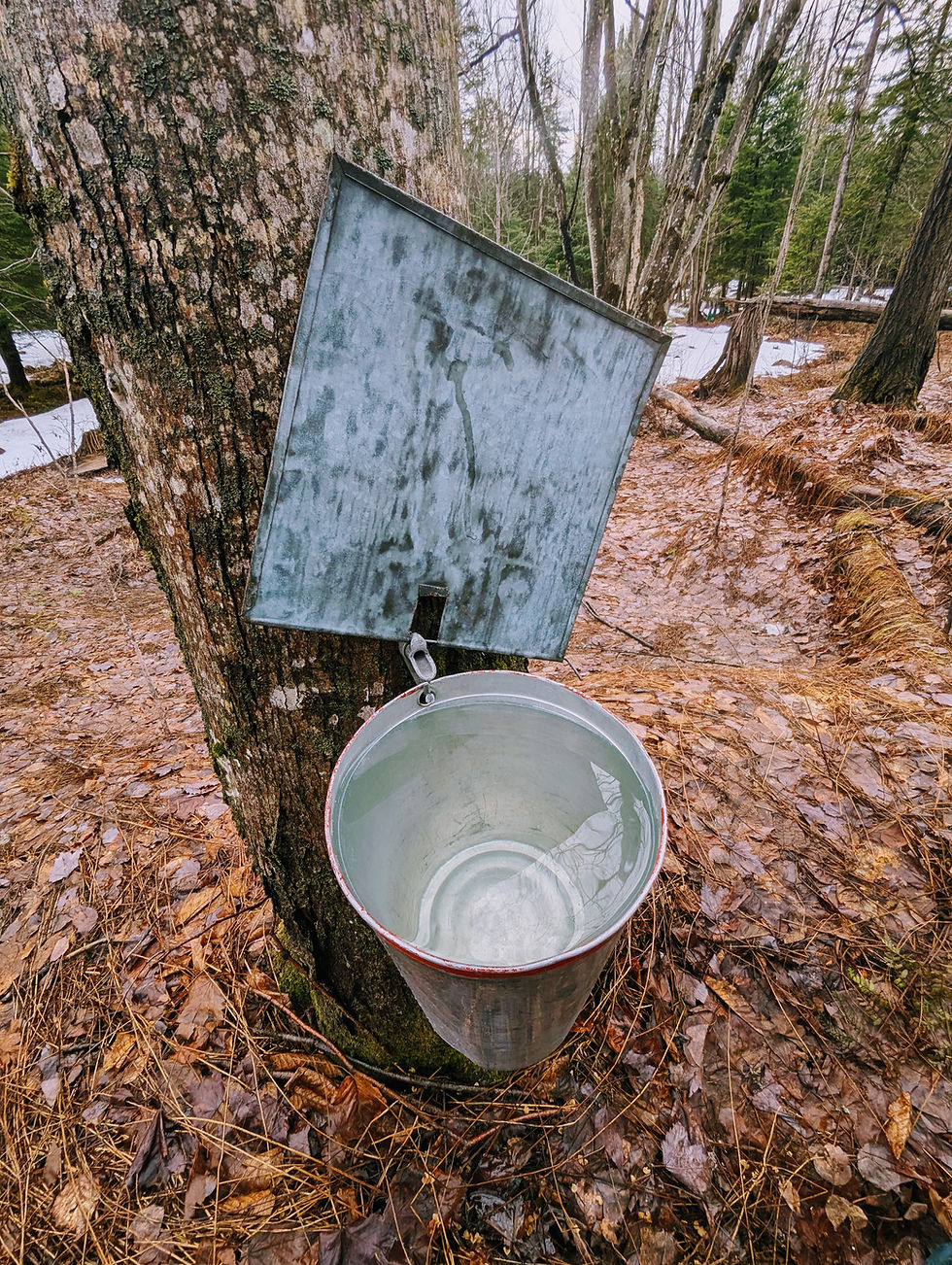
Now that the tapping is done, we can get on with the rest of the syrup-making process at Emerald Mountain Farm. As the days grow warmer and the nights continue to drop below freezing, the sap begins to flow. All around you, you can hear the steady dripping of sap falling into metal buckets. Spring has finally arrived! It's been an interesting process as we try new things and find what works best for us in our collecting and boiling.

It has continued to be mostly cloudy, raining on us from time to time. The mud has also been quite something as the frost below the ground persists, making it impossible for surface water to sink below the surface and run away.
We are really enjoying collecting the sap! Usually, when you tell people you're using buckets, they get that look in their eye and say, "That's going to be a lot of work." And while I agree, I have to say, having now done both lines and buckets, I think the work evens out to the same thing. True, I have to get out there and gather my sap by hand, and I also have to make sure my buckets don't overflow. But I don't have to worry about walking through the woods to fix lines or remove fallen trees. I don't have to replace lines every x number of years, and I also don't have to stay up until two in the morning to make sure the temperature doesn't drop on me and freeze all my pumping lines solid.
The hard work actually makes me very happy.
This is my favourite time of year to be out in the woods because it's starting to warm up, but the bugs aren't out yet. I enjoy the lifting and carrying and the feeling of the good spring air in my lungs and the blessing of health and strength. I think one of the reasons I've always been so happy at this time of year, even when I suffered from terrible depression, was because I was engaged in so much physically taxing work. It did wonders for me mentally, and I felt my best.

Over the last couple of weeks, we've had good syrup-making weather, so we have spent much time in the woods gathering sap. We hope next year our oxen can pull a tank through the woods for us, but they are still a little young for that yet. This year, we have been using a quad on our trails with a trailer attached. Inside a wooden rack on the back of this trailer are two fifty-gallon barrels. Gary designed a set of pipes and valves that connect these barrels to a box on top. We go out to the trees with five-gallon buckets, pour the sap from the metal buckets into our collecting buckets, and when these are full, we mount the steps at the back of the trailer and dump the buckets into the box on top of the barrels. The sap then feeds from the box, through the tubes, and into the barrels below. It is much easier to use a five-gallon bucket to haul the sap from the trees to the trailer because it cuts down on a lot of trips back and forth, especially when the metal buckets on the trees don't have much in them.

When we have collected all the sap our barrels will hold, we haul it back to the sugar shack and pump it into our two-hundred and seventy-five gallon holding tank next to the sugar shack. The sap is stored in this tank until we are ready to start boiling.
We bought an old boiler earlier this winter that is about 3' by 15' and holds around seventy-five gallons of sap. On average, it boils fifty to sixty-five gallons of sap an hour, allowing us to draw off finished syrup about once an hour. It is wood-fired and works quite well.

We do not have a reverse osmosis system to remove water from our sap, so having a boiler of this size has allowed us to boil more sap at a time, thus making it possible for us to be done more quickly. I still love the tiny boiler Gary built for me when we lived in the apartment in Roxton Falls, but it would have taken forever to boil off this much sap in such tiny pans!
It took me a couple of boils to get used to the new boiler, but after I became acquainted with its ways, I began to settle in and enjoy the rhythm of boiling again. A few days ago, mom helped us collect sap before heading home to do some housework and make supper. Gary had some projects to do around the farm, so once we got the boiler started up (it took forever this time because everything was so wet!) it was just the boiler and I. It's funny because this boiler is much quieter than my little one. To blow air into the wood box of my old boiler, I used a hairdryer (yes, you can laugh. It worked well, though!). This new boiler has a cage fan with wheels and a belt on the outside, and it's one of the quietest boilers Gary or I have ever used. It's been fantastic. You can hear the sound of the sap bubbling in the pans and the birds outside with your nose fills with the inviting scent of hot sap.

Making maple syrup is pretty cool because it's a science. A boiler is made up of a series of metal pans connected by pipes. Sap feeds down into the back pan, where the temperature is the lowest. By the flow of gravity, the sap travels through the pans,, becoming hotter, heavier, and more concentrated until it reaches the last and hottest pan where it eventually boils into maple syrup. The sugar in maple syrup is measured in what is called brix. We use a small hand-held device called a refractometer to measure the amount of sugar in the syrup. Maple syrup is not legally syrup until it reaches sixty-six brix of sugar.

It takes approximately forty gallons of maple sap to make a gallon of maple syrup, but this can all depend on the year; some years the sugar content is very low in the sap, other years it is higher. Trees that get more light will also produce sweeter sap, so again, this is all dependent on many variables.
Sugaring off is a tradition that spans hundreds of generations, making it something special that runs through the blood of the Québécois people. Every spring, when the first hint of longer days and warmer weather begins to peep over the horizon, and winter quietly falls asleep, the fever seizes us and take to the bush once more. With Quebec making a staggering seventy-five percent of the world's maple syrup, it is no wonder you are able to spy so many steaming sugar shacks on warmer spring days. If your neighbour doesn't own or rent a sugar bush where they make maple syrup in the spring, then they are going off for the weekend to help their brother or uncle who does.

While modern science has tried to move in and automate some of how we harvest this springtime crop, sugaring off still seems to cling largely to an ancient way of living, and mystery still baffles the modern farmer. We can't control the weather, and we can't make the sap run. We never know what kind of season we will have. Despite labour-saving devices and techniques, you still have to get out there on your snowshoes every year and manually tap each tree. We still haven't quite figured out why the sap will sometimes run at a dizzying rate when the temperature hovers around zero, but then will flow sluggishly at say, plus seven. Why does the sap often run so well when it rains? And how is it that you can guarantee three days after all the peepers wake up and start to sing, that your sap will sour and your season will be over? I think God planned it that way. I think we feel like we have control over pretty well every last detail in our lives, from the way we grow our food in greenhouses to being able to board a plane in the morning on one side of the country and step out of it in the evening on the other side of the country. I think it's good for us to wonder at how God designed His creation. It is good for us to realize we don't have all the answers and that we can't control everything around us. That's God's business. I think it would be sad if we had control of everything. We would hardly ever talk to God. We wouldn't have any reason to ask for a good harvest or say thank you for it when it came. We'd never get that warm connection with God that comes from asking and receiving and we would cease to be amazed, and full of that child-like wonder that comes from realizing you are part of a world so big, so beautiful and vast and so beautifully mysterious.


Comments